A swarm of tiny earthquakes is giving scientists a clearer picture of one of the most dangerous seismic regions in North America.
Researchers say tracking very small, low-frequency earthquakes is helping them better understand the complex area where the San Andreas Fault meets the Cascadia subduction zone, a region capable of producing devastating major earthquakes.
The findings, published Jan. 15 in the journal Science, offer new insight into tectonic processes occurring offshore near Northern California.
Scientists say the research could improve long-term assessments of earthquake hazards affecting the West Coast.
Tiny Earthquakes Reveal Hidden Activity Beneath Major Faults
The study focuses on a geologically complex area known as the Mendocino Triple Junction, located off the coast of Humboldt County, California.
This is where three massive tectonic plates—the Pacific Plate, the North American Plate, and the Gorda (Juan de Fuca) Plate—meet.
While the surface map shows clear fault boundaries, scientists say the reality beneath the Earth’s crust is far more complicated.
By tracking thousands of tiny earthquakes, researchers are uncovering how these plates interact deep underground.
Understanding the Mendocino Triple Junction
South of the triple junction, the Pacific Plate moves northwest past the North American Plate, forming the well-known San Andreas Fault.
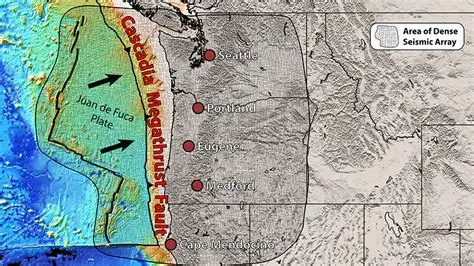
To the north, the Gorda Plate, part of the larger Juan de Fuca system, dives beneath the North American Plate in a process called subduction.
This subduction zone is part of the broader Cascadia Subduction Zone, which stretches from Northern California into Canada.
The collision of these different plate motions creates a uniquely complex and potentially hazardous seismic environment.
Why This Region Poses a Major Earthquake Risk
Scientists have long known the Mendocino Triple Junction is seismically active.
However, past earthquakes have raised new questions about what is happening beneath the surface.
One example is a magnitude 7.2 earthquake in 1992, which occurred at a much shallower depth than expected.
That event suggested that traditional fault models may not fully capture how stress is distributed in the region.
Studying the Earth Like an Iceberg
First author David Shelly, a researcher with the U.S. Geological Survey (USGS), compared the challenge to studying an iceberg.
Only a small portion of tectonic activity is visible at the surface, while much more occurs out of sight deep underground.
To understand earthquake risk, scientists must determine how faults and plates are arranged below the Earth’s crust.
The new study aims to illuminate those hidden structures.
Using Low-Frequency Earthquakes to Map the Subsurface
The research team used a network of seismometers across the Pacific Northwest to detect extremely small earthquakes.
These low-frequency earthquakes occur when tectonic plates slowly rub against or slide over one another.
They are thousands of times weaker than earthquakes felt by people at the surface.
Despite their size, these events provide valuable clues about stress and motion deep within fault systems.
Collaboration Across Leading Research Institutions
The study was conducted by scientists from the USGS, the University of California, Davis, and the University of Colorado Boulder.
Co-author Amanda Thomas, a professor of earth and planetary sciences at UC Davis, emphasized the importance of understanding underlying tectonic processes.
She noted that without this knowledge, accurately assessing seismic hazards becomes far more difficult.
The team also included researchers from the USGS Earthquake Science Center and CU Boulder.
How Tidal Forces Help Confirm the Model
To validate their findings, researchers examined how tectonic plates respond to tidal forces.
Just as the Moon and Sun influence ocean tides, their gravitational pull also affects Earth’s tectonic plates.
When tidal forces align with the natural direction of plate motion, scientists expect to see an increase in small earthquakes.
The observed patterns matched the researchers’ predictions, strengthening confidence in their model.
What This Research Means for Earthquake Forecasting
Scientists caution that the study does not predict when or where the next major earthquake will occur.
However, it provides a more detailed understanding of how stress builds and releases along complex fault systems.
This information is critical for improving long-term seismic hazard assessments.
Better models help planners and emergency managers prepare for potential future earthquakes.
Public and Scientific Interest in Cascadia Risks
Public interest in the Cascadia Subduction Zone has grown in recent years due to concerns about a possible large earthquake.
The zone is capable of producing magnitude 8 to 9 earthquakes, though such events are rare.
Researchers say studies like this one help refine estimates of where stress is accumulating.
Clearer scientific understanding also supports better public education and preparedness.
What Happens Next in the Research Process
Scientists plan to continue monitoring low-frequency earthquakes in the region.
Future research may integrate additional data from offshore sensors and satellite measurements.
As monitoring technology improves, researchers hope to further refine models of plate interactions.
Ongoing collaboration among institutions remains key to advancing earthquake science
KEY FACTS AT A GLANCE
| Category | Details |
|---|---|
| Event | New earthquake research published |
| Location | Mendocino Triple Junction, Northern California coast |
| Date | Jan. 15 |
| Who Is Affected | West Coast residents, seismic researchers |
| Current Status | Study published in Science |
| What Readers Should Know | Tiny earthquakes reveal hidden fault behavior |
FREQUENTLY ASKED QUESTIONS
What is the Mendocino Triple Junction?
It is where three tectonic plates meet off Northern California.
Why is this area important?
It links the San Andreas Fault and the Cascadia Subduction Zone.
What are low-frequency earthquakes?
Very small earthquakes caused by slow plate movement deep underground.
Can these earthquakes be felt?
No, they are far too small to be felt at the surface.
Does this study predict a major earthquake?
No, it improves understanding of long-term seismic risk.
How does this research help the public?
It supports better hazard assessments and preparedness planning.
By tracking swarms of tiny earthquakes, scientists are gaining a clearer view of one of North America’s most complex seismic regions.
While the research does not forecast specific earthquakes, it provides critical insight into how tectonic plates interact beneath the surface.
Experts say continued monitoring and study will be essential to improving earthquake hazard understanding along the West Coast.




Leave a Comment