Aurora Borealis Watch: NOAA Forecasts Visibility Across 40 Northern Counties From Alaska to Michigan as Storms Intensify
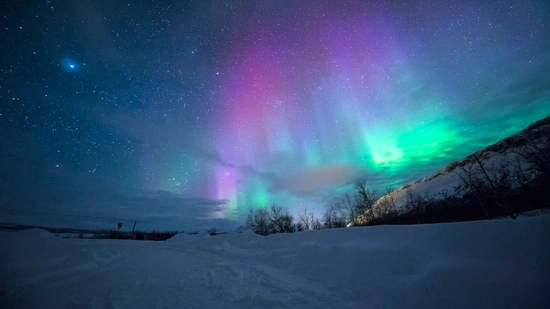
The northern lights could return to U.S. skies this weekend, with NOAA forecasting elevated geomagnetic activity that may make the aurora borealis visible across more than 40 northern counties from Alaska to Michigan.
The National Oceanic and Atmospheric Administration (NOAA) is predicting a Kp index of 5, which indicates a minor geomagnetic storm on a scale where 9 is the strongest. This means brighter, more vibrant auroras may be visible for those in the right locations and under clear skies.
The forecast applies to Friday night, early Saturday morning, and Sunday, with similar activity expected through the weekend.
NOAA says the increased auroral activity is linked to coronal holes on the sun’s surface, which are sending high-speed solar wind toward Earth and causing geomagnetic disturbances.
NOAA Issues Aurora Alert for Multiple U.S. States
NOAA notes that the best viewing conditions will occur in northern Canada and Alaska, but there is also a possibility for visibility in several U.S. states if conditions align.
States with higher viewing likelihood include:
- Alaska
- Northern Canada
States with moderate to lower chances, depending on cloud cover and light pollution, include:
- Washington
- Idaho
- Wyoming
- North Dakota
- Minnesota
- Wisconsin
- Michigan
A lesser but still possible chance exists for:
- Montana
- South Dakota
- Iowa
- New York
- New Hampshire
- Vermont
- Maine
These areas collectively cover over 40 counties that fall within NOAA’s projected view line.
What Is Causing the Aurora Boost This Weekend?
According to NOAA, the expected auroral activity is due to the “anticipated influence” of a coronal hole.
Coronal holes are cooler regions on the sun’s surface that emit fast-moving streams of solar wind.
When this solar wind interacts with Earth’s magnetic field, it can cause:
- Geomagnetic disturbances
- Increased auroral activity
- Brighter and more widespread northern lights
For this weekend, NOAA forecasts:
- Kp index 5 on Friday
- Kp index 4 on Saturday
- Kp index 4 on Sunday
These values indicate minor but potentially visible auroral displays.
Best Time and Place to See the Northern Lights
NOAA recommends that viewers:
- Look between 10 p.m. and 2 a.m. local time
- Travel as far north as possible
- Seek a high, north-facing vantage point
- Avoid urban light pollution
- Monitor cloud cover in real time
Even when auroras are forecast, visibility depends heavily on weather conditions and local light pollution levels.
Photography Tips for Capturing the Aurora
Experts suggest the following techniques for photographing the northern lights:
For DSLR or Mirrorless Cameras
- Use an aperture of f/4 or lower
- Set focus to infinity
- Use a tripod to prevent blur
- Shoot in manual exposure mode
For iPhone Users
- Enable Night Mode
- Use a tripod or stable surface
- Adjust exposure to brighten the sky
For Android Users
- Switch to Pro Mode
- Manually set ISO and exposure
- Use a tripod for clarity
Public Reaction
As NOAA issued the updated forecast, social media quickly filled with excitement from skywatchers in northern states.
Residents in Minnesota, Michigan, and Wisconsin posted messages asking for the latest cloud cover forecasts, while many in New England celebrated the possibility of rare sightings.
Several astronomy groups also encouraged people to check NOAA’s Aurora Dashboard for real-time updates and Kp index changes throughout the weekend.
What Happens Next?
NOAA will continue monitoring the sun for new solar wind streams and coronal hole dynamics.
Changes in solar activity could raise or lower the Kp index with little notice.
Residents in northern U.S. states are advised to:
- Check local cloud forecasts before heading out
- Stay updated with NOAA space weather alerts
- Watch for sudden increases in the Kp index
- Remain aware of rapidly changing conditions
If the solar wind intensifies, auroral visibility could expand farther south.
Key Facts Summary Table
|
Event |
NOAA Aurora Borealis Forecast |
|
Location |
Alaska, Upper Midwest, Northern & Northeastern U.S. |
|
Date |
Friday through Sunday |
|
Counties Affected |
40+ northern counties across multiple states |
|
Kp Index Forecast |
5 on Friday; 4 on Saturday & Sunday |
|
Cause |
Solar wind from coronal holes |
|
Viewing Time |
10 p.m. – 2 a.m. local time |
|
Recommendation |
Travel north, avoid light pollution, check sky clarity |
Frequently Asked Questions (FAQ)
1. What is the Kp Index?
The Kp index measures geomagnetic disturbances on a scale from 0 to 9. A higher number means stronger potential auroras.
2. What Kp Index is needed to see the northern lights in the U.S.?
Most northern U.S. states can see auroras at Kp 5 or above, depending on sky conditions.
3. When can I see the aurora this weekend?
NOAA recommends viewing between 10 p.m. and 2 a.m. local time on Friday, Saturday, and Sunday.
4. Which states have the best chances?
Alaska and northern Canada have the strongest likelihood. Lower 48 chances include Minnesota, Wisconsin, Michigan, and the Pacific Northwest.
5. Do clouds affect aurora visibility?
Yes. Even strong auroras cannot be seen through thick cloud cover.
6. Can I photograph auroras with a smartphone?
Yes. Use Night Mode (iPhone) or Pro Mode (Android) and stabilize your phone on a tripod.
7. Will the aurora be visible farther south?
Possibly, but only if solar wind increases. Current forecasts support northern regions only.
Meteorologists are also closely monitoring regional cloud cover, which may determine whether residents in northern states can actually see the auroras despite NOAA’s elevated Kp index forecast. Early models suggest patchy cloud conditions across parts of Minnesota, Wisconsin, and Michigan on Friday night, with improved clarity expected late Saturday into early Sunday.
Alaska is expected to have mostly favorable viewing conditions, particularly in interior regions. However, areas along the Pacific Northwest, including northern Washington, may experience intermittent cloud bands that could obstruct visibility at peak times.
NOAA’s Space Weather Prediction Center notes that geomagnetic activity may fluctuate throughout the weekend as solar wind speeds vary, meaning real-time monitoring will be crucial for skywatchers.
In some cases, auroral activity can briefly intensify without warning when pockets of fast-moving solar wind interact with Earth’s magnetic field, temporarily expanding visibility farther south than originally forecast. Because of this potential variability, NOAA encourages viewers to monitor live Kp index charts and aurora trackers, especially during late-night hours when visibility is typically strongest.